Tuesday, September 7, 2010

The Butterfly Effect: How Your Life Matters by Andy Andrews


Andy Andrews in The Butterfly Effect: How Your Life Matters asks the question, “Do I really matter?” Andrews answers the question by telling two stories. The first tale details the heroic efforts of Joshua Lawrence Chamberlain at the Battle of Gettysburg during the Civil War. Chamberlain, a man who refused to do nothing, ordered a historic charge that allowed Union forces to win the battle, when a Confederate victory could have decisively changed the history of the United States and the 20th Century. The second story Andrews presents is the chain of effects that led to the development of hybridized high yield, disease resistant corn by Norman Borlaug, a historical figure likely not to be familiar to most readers. Borlaug’s creation has saved billions from famine. But Andrews asks was it Borlaug’s efforts that led to the saving of more than two billion or was it the small efforts of others that lead to Borlaug’s work. Andrews shows that as the Butterfly Effect argues, all of our smallest actions have impacts, and Andrews inspiringly shows that those little things have long term impacts.

This is a gift book, so it’s short. To be honest I have thought about this book for more time than it took for me to read it. The book is visually pleasing starting at the cover, with a shiny butterfly graphic. As the great philosopher Jeff Foxworthy once argued, men are attracted to shiny things. The pages are more graphical than textual. I’m not a huge fan of gift books, but I found myself satisfied with The Butterfly Effect and am glad I took the time to read and reflect on it.

Review Copy provided by Thomas Nelson

Thursday, July 22, 2010

Beyond Opinion: Living the Faith We Defend Edited by Ravi Zacharias


Ravi Zacharias guided the collection of essays by his Ravi Zacharias International Ministries (RZIM) staff in Beyond Opinion: Living the Faith We Defend which covers topics as diverse as challenges from non-Christian world religions, evil in the world, spiritual transformation and living a Christ centered life. The text is broken into three sections. The first section, “Addressing the Difficult Questions” provides essays on other world religions including Islam and Hinduism, answering atheists, and engaging youth culture. Additional essays discuss the basics of conversational apologetics, challenges from culture and the challenges of evil and suffering. The second section, “Internalizing the Questions and Answers” provides advice on spiritual growth including dealing with self-deception and a better understanding of the Trinity. In the final section Zacharias provides the two essays in “Living Out the Answers” providing a call for Christians to live out what they speak and claim to believe including practical advice on strengthening one’s body and mind.

To be blunt, this book is and is intended to be heavy lifting. The text covers deep philosophical and theological issues. Therefore this book is likely not for every reader or even mood. It reads much more like a text book than a self help/spiritual growth book in some of the essays. And, being written by multiple authors, the quality of the chapters varies. It is sometimes frustrating to have authors quoting heavily from other authors also in the book, finding me asking what do they think not their colleagues or if they relied so heavily on this essay author why didn’t they write this chapter. Likewise it would be nice to have authors include more personal stories instead of summarizing their study on the topic. The chapters on other religions though informative weigh heavily on global religions which many may not interact with on a daily basis. It would have been a nice addition to include chapters on the Church of Latter Day Saints or Jehovah’s Witnesses as religions that many Christians in the United States may literally have knocking on their door and struggle in understanding Personally, I think the subtitle of “Living the Faith We Defend” is somewhat misleading as only one chapter, which is written by Zacharias, truly addresses living out our faith in a sincere and informed way which was really the topic I wished for the book to address.

Review Copy provided by Thomas Nelson


Thursday, June 24, 2010

You Can Be Everything God Wants You to Be by Max Lucado


You can Be Everything God Wants You to Be by Max Lucado is a repackaging of selections found in Lucado’s earlier book Cure for the Common Life. The text includes short chapters or selections that highlight Lucado’s ability to write theological concepts in an engaging manner. Lucado reinforces to his readers that they are uniquely made by God, suggests that the best way to live is to do is glorifying God by using one’s uniqueness. Lucado urges readers to understand their S.T.O.R.Y (Strengths, Topics, Optimal Conditions, Relationships, Yes!) in order to move into the sweet spot of life. These concepts are passed on within a book designed with a number of pictures and Biblical reflections which could be used for self reflection.

I really wanted to like this book, but it’s a mess. And from my read it appears to be the repackaging that has created the problems and not the text itself. I would like to have used this as a devotional type book much like Lucado’s Grace for the Moment since its clearly not the deeper dive of this material, which would be the full version in Cure For the Common Life. However the varying sizes of the chapters make it difficult to use the text for a devotional, with chapters ranging from one page, two if you count a title page, to five or more pages. Even more confusing are the use of different sized texts and colors which I am still not sure if they indicate a major point, a supporting point or are part of the general text as the beginning of a sentence. The content appears uneven and inconsistent, the presentation of the S.T.O.R.Y. concept for example includes chapters of various sizes and is introduced, built on later in the text, disappears and then returns. At one point in a story a character is introduced as Chief Wiggles and then later on the page it is explained how Halverson earned that nickname, but Halverson was never really introduced to us. I would have been less confused if the Halverson reference was just left out. And finally, Matthew 25:15 is given emphasis on two different pages, pages that only have a chapter title, the verse and a picture. It seemed odd to have the same verse used in such a way twice, but even more frustrating that the page 12 reference identifies the verse as 25:25. It really appears that editing has done this text no favors. The cover proudly displays a sticker that the book is perfect for a graduate. I think there are plenty of better graduation gifts including other books by Lucado.
Review Copy provided by Thomas Nelson

Friday, June 4, 2010

The Heart Mender: A Story of Second Chances by Andy Andrews


The Heart Mender by Andy Andrews presents two compelling and engaging stories. The first story, which consists of parts 1 and 3 of the book, tells the story of Andrews’ discovery of World War II German U-Boat artifacts in his Gulf Coast yard and his own personal journey to uncover the origins of how these items got into his yard. The second story details the ramification of a chance encounter between Josef a German submariner who becomes separated from his German U-Boat while patrolling the Gulf of Mexico during 1942 and Helen a woman deeply hurt by personal loss leading to anger with God and everyone she is in contact with. Their story is one of grace and ultimately forgiveness allowing each to gain a fresh start on life.

I started this book expecting it to read much like Andrew’s The Traveler’s Gift which used an interesting story to present a number of principles. Instead, this book uses both stories to underscore one valuable lesson, the power of forgiveness and the freedom it gives the forgiver. The book itself and both stories within it are engaging. This combined with the fact that the story is based on real people, made it difficult for me to keep from peeking to the end of the book and where they are now section or searching the internet for information about U-166, Josef’s boat. The story of Josef and Helen combine elements that both men and women will enjoy, giving the reader images of both U-571 and The Notebook as they race through the text. If Andrews’s goals were to entertain and provide a valuable lesson about forgiveness, he has achieved his desire. The Heart Mender is a release of Andrews’ Island of Saints, which he notes had a vocal but small audience. This rerelease will hopefully expose more readers to this engaging tale.

Review Copy provided by Thomas Nelson


Monday, May 3, 2010

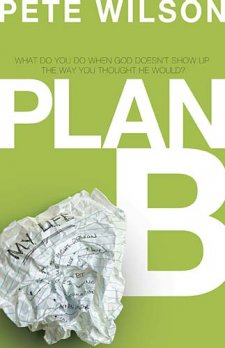
Plan B: What Do You Do When God Doesn’t Show Up in the Way You Thought He Would? by Pete Wilson


Pete Wilson in Plan B takes his readers through various stages of what happens when one’s plans fall apart, or as Wilson says what happens when God doesn’t show up the way you planned. As a pastor, Wilson lives and works among those experiencing personal tragedies and triumphs. Wilson sprinkles his book with stories of these folks and their Plan B experiences along with Biblical principals pulled from the lives of Biblical figures and the teachings of Jesus. In the end, Wilson admits he does not have easy answers for those facing a Plan B. He readily admits he has no Bow to tie his book together with easy to follow steps to walk one through a Plan B. However he does constantly turns us back to God. He reminds us that God does not change, that God keeps his promises, that God uses Plan B to strengthen our faith in him, and regardless of the resolution and our own perceptions of it, He will finish what he started. In the end, while there may not be easy answers, we do have God and his love for us.

I read this book in the middle of my own Plan B situation, in fact, maybe a few Plan Bs. So I found the book timely and encouraging. It was a long time ago since I wanted to be an astronaut and not that long ago my heart screamed to be in fulltime ministry. It has become clear throughout these experiences, Wilson is right. As rough as I may have felt the situation was at times, God clearly was with me. And I have had to constantly reconfigure my own view towards planning. I now find that when I am open to the movement of God, I am less likely to be shattered by plans that did not happen and also have greater rewards. I also appreciate Wilson’s frankness. He does not attempt to set up 7 easy steps towards success in my plan B. Instead he shows how Jesus, Joseph and others from the Bible faced their Plan Bs (both successfully and poorly). I honestly appreciate that he does not try to solve every problem with a Band-Aid of clichés. In the end, Wilson had crafted a nice resource for those facing challenges to their hopes and dreams.
Review Copy provided by Thomas Nelson

Wednesday, April 21, 2010

Wild at Heart: Discovering the Secret of a Man’s Soul (Revised) by John Eldredge


John Eldredge in Wild at Heart argues that a desire for adventure has been knitted into the heart of everyman. He believes that everyman wishes to be the warrior, the adventurer, the knight, and the hero and that American culture, including the church, has attempted to suppress these God written desires of a man’s heart. Eldredge gives his reader permission to unlock those desires and unleash the wild man within them. Much of the focus in unlocking a man’s heart is the realization of a spiritual wounding, likely caused by a father figure and a establishment with of proper relationship with one’s heavenly father. By allowing men to return to their nature of wildness, Eldredge challenges his reader to participate in the great adventure that life and a relationship with God provide.

This is the revised edition of Wild at Heart, a book I have known of for several years. I had avoided it fearing Eldredge would challenge me to move into the woods for an extended period of drum playing and living off berries. I found that my reluctance to read Wild at Heart earlier to be a mistake. The text speaks to a man’s soul, with Eldredge hitting on themes such as the desire for adventure that resonates with everyman. Additionally, I have found that the content has led to other deep spiritual conversations with other men. In the end I find myself reflecting on The Lion, the Witch and the Wardrobe. Aslan is described as a safe but not tame lion. I find myself after reading Eldredge why have I allowed myself to become tamed and how to I return myself to the wild and give my son permission to never be tamed.
Review Copy provided by Thomas Nelson

Sunday, March 14, 2010

Everyone Communicates Few Connect: What the Most Effective People Do Differently by John C. Maxwell

John C. Maxwell in Everyone Communicates Few Connect provides guidance to help leaders move from talking and sharing information to connecting to audiences, ranging from one on one to large audiences. Maxwell breaks his work into two parts; principles the theory of connection, and practices, how to connect. At the end of each chapter, Maxwell provides an overview of the major points of each chapter and tips on applying each chapter’s content for different audiences. The author reminds us that in order to be effective we must connect. Overall this book provides tools to improving oneself as a communicator and more importantly as a leader by connecting messages with audiences.

To be honest, many of the principles and practices in this book are not new material. We all know, or should know, that in order to be a successful communicator one needs to energetic, you need to care about your audience and you need to be credible. Despite this, we all need reminders of these “facts” and Maxwell does an excellent job of collecting common sense and practical principles and tips for successful communication. Personally, this book has lead me to self assess how I communicate to a large group in my own workplace. I find myself asking, is it about me or them, and I credible, do I give them credit, do I make them insiders and many many more. This book is a great resource for anyone who needs to communicate, which is pretty much everyone!

Review Copy provided by Thomas Nelson