Soul Print: Discovering Your Divine Destiny by Mark Batterson encourages readers to discover their true self and their personal destiny. Batterson argues that everyone has a soul print, which defines not just who one is but who one is destined to become. He adds that our soul print is who God has designed us to be and that it contains our uniqueness. He urges us to embrace our soul print, to have the courage to be ourselves and to not experience regret by failing to be who we were individually designed to be. Batterson then explores the life King David and how his soul print played out in his life. He shows us that our past experiences and weaknesses help us to understand who we are. He shows how like David, our character will be challenged both through experiences and the words of others to behave differently than we have been built. And Batterson shows how accepting our soul print leads to personal success, while rejecting it causes pain in our lives.
Overall, this is an easy book to read. Many readers will be familiar with the stories that Batterson has selected from David’s life providing reassurance that you know where Batterson is heading. And Batterson’s writing style is easy to read. The author’s honesty and willingness to share his own faults also makes the text relatable. He presents several thoughts that many of us have to deal with in our own lives. I’m still meditating on, “I’d rather by hated for who I am than love for who I’m not( Batterson, 102).” So many in ministry have people pleasing personalities realistic talk that this is a bitter but needed pill to swallow. It’s very encouraging to have such a visible and successful pastor provide that pill in a discussion of his own failures.
Review Copy Provided by WaterBrook Multnomah
Showing posts with label Christianity. Show all posts
Showing posts with label Christianity. Show all posts
Sunday, January 16, 2011

Thursday, November 18, 2010
The Next Christians: The Good News About the End of the Christian Era
In 2007 Gabe Lyons collaborated with David Kinnamen in unChristian a book that showed us the reality of societies views about those who label themselves Christian. Since I had a friend gift me a copy, I have quoted and referred friends and others to this important text and their advice for overcoming the poor impression that society has of Christians. In The Next Christians not only tells us how to overcome negative Christian stereotypes, but he tells us who will destroy them. Lyons leaves his reader excited for the next movement of God through the next Christians, the restorers. These next Christians struggle against the reality of the world seeking to restore creation to what it ought to be not what it is. The restorers place high value on truth, justice, and beauty. Lyons describes in detail the key characteristics of restorers including their high value on calling, community, countercultural behavior, active engagement with culture and a firm foundation in Jesus Christ. If Christianity has lost its relevance by removing itself from the center of culture, the restorers are our best hope to return saved people to the culture conversation.
The Next Christians is a phenomenal book. Lyons has an ability in his writing to connect all of the dots to things we have all seen in our churches and society in large. As he writes about examples of restorers he knows you begin to think of those in your own life. Those examples that come to mind only further show the truth of Lyons’ writing. Additionally, the book is easy to read due to the engaging material. Honestly, as I got to better understand some of those I interact with, I got excited. I was also challenged with questions about myself as a potential restorer, where I am fighting against the restorers, and how can my own background help sharpen restorers. Lyons’ words lead me to celebrate much of what I do, and also grieve my own non-restorative tendencies. What more can we ask of a book other than lead ourselves down a path of self reflection? The Next Christians also helps reinforce books like Not Like Me. The Next Christians provides a general behavioral overview of restorers, while Eric Bryant in Not Like Me describes the relational toolbox of restorers, though he never makes that claim. The Next Christians is an important book that we as the church need to be discussing and acting on so we can move the Jesus conversation back to the center of the cultural dialogue.
Review Copy Provided by WaterBrook Multnomah
The Next Christians is a phenomenal book. Lyons has an ability in his writing to connect all of the dots to things we have all seen in our churches and society in large. As he writes about examples of restorers he knows you begin to think of those in your own life. Those examples that come to mind only further show the truth of Lyons’ writing. Additionally, the book is easy to read due to the engaging material. Honestly, as I got to better understand some of those I interact with, I got excited. I was also challenged with questions about myself as a potential restorer, where I am fighting against the restorers, and how can my own background help sharpen restorers. Lyons’ words lead me to celebrate much of what I do, and also grieve my own non-restorative tendencies. What more can we ask of a book other than lead ourselves down a path of self reflection? The Next Christians also helps reinforce books like Not Like Me. The Next Christians provides a general behavioral overview of restorers, while Eric Bryant in Not Like Me describes the relational toolbox of restorers, though he never makes that claim. The Next Christians is an important book that we as the church need to be discussing and acting on so we can move the Jesus conversation back to the center of the cultural dialogue.
Review Copy Provided by WaterBrook Multnomah
Friday, October 29, 2010
Not Like Me: A Field Guide for Influencing a Diverse World by Eric Michael Bryant
Eric Michael Bryant in Not Like Me connects authentic relationships with impacting others for Jesus. Bryant provides a call to engage those that don’t look like us, share our culture or even believe the same as us. In fact he goes so far as to call us to love those people that the Christian mainstream hates. He notes that typically we push away people that don’t think or behave as we do removing our ability to influence them. Bryant instead points out the need to engage these not like me people in true friendships. He urges us to love people without judgment or conditions, realizing that though one may not have a relationship with Jesus, that God still loves that person unconditionally. This is the example that we must follow. Bryant shows that only be entering true relationships with people not like us can we have a lasting impact on their lives and help to show them the power of Jesus.
I have to be honest; I have wanted to read this book from when it was first issued as Peppermint-Filled Piñatas. I’m very happy to say I was not disappointed. Bryant writes what we know in our own hearts, without a relationship with people we cannot expect to successfully impact them. But not only must we have a relationship, we must have a relationship built on love, respect and honesty not one based on a hidden agenda. By being honest we learn more about others and ourselves. Bryant reminds us that Jesus immersed himself amongst those that the religious establishment considered outsiders. And he angered that establishment as he moved salvation past a religious system of dos and do nots to a relationship with a living God. Not Like Me reminds us the simplest and best way for us to introduce someone to a friend, is to be a friend first.
I think this is an important work. Bryant urges us to move past our fears and preconceptions of others, others that we look down at, don’t understand and honestly fear for their cultural and moral choices and to look at people. Basically, he challenges us to look at people as people, not as sinners. By following Bryant’s charge and advice on friendship building we can find that key to demolishing the negative opinions that general public has of Christ followers especially charges of hate filled and judgmental. Not Like Me reminds us that like Jesus to save people we must first love people.
I have to be honest; I have wanted to read this book from when it was first issued as Peppermint-Filled Piñatas. I’m very happy to say I was not disappointed. Bryant writes what we know in our own hearts, without a relationship with people we cannot expect to successfully impact them. But not only must we have a relationship, we must have a relationship built on love, respect and honesty not one based on a hidden agenda. By being honest we learn more about others and ourselves. Bryant reminds us that Jesus immersed himself amongst those that the religious establishment considered outsiders. And he angered that establishment as he moved salvation past a religious system of dos and do nots to a relationship with a living God. Not Like Me reminds us the simplest and best way for us to introduce someone to a friend, is to be a friend first.
I think this is an important work. Bryant urges us to move past our fears and preconceptions of others, others that we look down at, don’t understand and honestly fear for their cultural and moral choices and to look at people. Basically, he challenges us to look at people as people, not as sinners. By following Bryant’s charge and advice on friendship building we can find that key to demolishing the negative opinions that general public has of Christ followers especially charges of hate filled and judgmental. Not Like Me reminds us that like Jesus to save people we must first love people.
Friday, September 10, 2010
Outlive Your Life: You Were Made to Make a Difference by Max Lucado

Max Lucado in Outlive Your Life: You Were Made to Make a Difference provides advice on leaving a lasting impression on this world with the resources God has given you. Lucado walks through key verses in the Book of Acts, using stories to bring the point of the verses out to his readers. He describes how the Book of Acts shows a small group of devoted believers, with limited education, influence and resources impacted the world from their own time to this day. Lucado notes that the work of the Book of Acts continues to this day, providing a story that has not ended. Key principles the author shares in leaving a permanent mark on the world includes the primacy of prayer, relationships with other believers and non-believers and modeling Jesus’ concern for the poor. Each chapter if followed by a complimentary Biblical verse for reflection and a prayer to focus the reader on the chapter’s content. A discussion guide for small groups is also provided.
Outlive Your Life is a typical Lucado book with a key strength in engaging writing that expertly uses stories to highlight and teach Lucado’s points. Lucado’s clear and entertaining writing allows readers to briskly read the text. Additionally, I think the text is helpful in reminding the reader that Jesus cared for the poor and was sympathetic to those shunned by society. He calls for us to remove our headphones and look around to the brothers we can partner with and the non-brothers who needs our help, help we must give as a result of our salvation. Personally, the most challenging section for me was on prayer, where Lucado reminds us that Jesus did not call his house one of study, sermons or etc but a house of prayer. Being a studious person, it served as a stark reminder that prayer is essential. Lucado puts his actions where his mouth is, donating his royalties from the book to World Vision. Outlive Your Life is a challenging but readable book that challenges Christians to make lasting impacts in the name of Christ.
Review Copy Provided by Thomas Nelson
Tuesday, September 7, 2010
The Butterfly Effect: How Your Life Matters by Andy Andrews

Andy Andrews in The Butterfly Effect: How Your Life Matters asks the question, “Do I really matter?” Andrews answers the question by telling two stories. The first tale details the heroic efforts of Joshua Lawrence Chamberlain at the Battle of Gettysburg during the Civil War. Chamberlain, a man who refused to do nothing, ordered a historic charge that allowed Union forces to win the battle, when a Confederate victory could have decisively changed the history of the United States and the 20th Century. The second story Andrews presents is the chain of effects that led to the development of hybridized high yield, disease resistant corn by Norman Borlaug, a historical figure likely not to be familiar to most readers. Borlaug’s creation has saved billions from famine. But Andrews asks was it Borlaug’s efforts that led to the saving of more than two billion or was it the small efforts of others that lead to Borlaug’s work. Andrews shows that as the Butterfly Effect argues, all of our smallest actions have impacts, and Andrews inspiringly shows that those little things have long term impacts.
This is a gift book, so it’s short. To be honest I have thought about this book for more time than it took for me to read it. The book is visually pleasing starting at the cover, with a shiny butterfly graphic. As the great philosopher Jeff Foxworthy once argued, men are attracted to shiny things. The pages are more graphical than textual. I’m not a huge fan of gift books, but I found myself satisfied with The Butterfly Effect and am glad I took the time to read and reflect on it.
Review Copy provided by Thomas Nelson
Thursday, July 22, 2010
Beyond Opinion: Living the Faith We Defend Edited by Ravi Zacharias


Ravi Zacharias guided the collection of essays by his Ravi Zacharias International Ministries (RZIM) staff in Beyond Opinion: Living the Faith We Defend which covers topics as diverse as challenges from non-Christian world religions, evil in the world, spiritual transformation and living a Christ centered life. The text is broken into three sections. The first section, “Addressing the Difficult Questions” provides essays on other world religions including Islam and Hinduism, answering atheists, and engaging youth culture. Additional essays discuss the basics of conversational apologetics, challenges from culture and the challenges of evil and suffering. The second section, “Internalizing the Questions and Answers” provides advice on spiritual growth including dealing with self-deception and a better understanding of the Trinity. In the final section Zacharias provides the two essays in “Living Out the Answers” providing a call for Christians to live out what they speak and claim to believe including practical advice on strengthening one’s body and mind.
To be blunt, this book is and is intended to be heavy lifting. The text covers deep philosophical and theological issues. Therefore this book is likely not for every reader or even mood. It reads much more like a text book than a self help/spiritual growth book in some of the essays. And, being written by multiple authors, the quality of the chapters varies. It is sometimes frustrating to have authors quoting heavily from other authors also in the book, finding me asking what do they think not their colleagues or if they relied so heavily on this essay author why didn’t they write this chapter. Likewise it would be nice to have authors include more personal stories instead of summarizing their study on the topic. The chapters on other religions though informative weigh heavily on global religions which many may not interact with on a daily basis. It would have been a nice addition to include chapters on the Church of Latter Day Saints or Jehovah’s Witnesses as religions that many Christians in the United States may literally have knocking on their door and struggle in understanding Personally, I think the subtitle of “Living the Faith We Defend” is somewhat misleading as only one chapter, which is written by Zacharias, truly addresses living out our faith in a sincere and informed way which was really the topic I wished for the book to address.
Review Copy provided by Thomas Nelson
Thursday, June 24, 2010
You Can Be Everything God Wants You to Be by Max Lucado

You can Be Everything God Wants You to Be by Max Lucado is a repackaging of selections found in Lucado’s earlier book Cure for the Common Life. The text includes short chapters or selections that highlight Lucado’s ability to write theological concepts in an engaging manner. Lucado reinforces to his readers that they are uniquely made by God, suggests that the best way to live is to do is glorifying God by using one’s uniqueness. Lucado urges readers to understand their S.T.O.R.Y (Strengths, Topics, Optimal Conditions, Relationships, Yes!) in order to move into the sweet spot of life. These concepts are passed on within a book designed with a number of pictures and Biblical reflections which could be used for self reflection.
I really wanted to like this book, but it’s a mess. And from my read it appears to be the repackaging that has created the problems and not the text itself. I would like to have used this as a devotional type book much like Lucado’s Grace for the Moment since its clearly not the deeper dive of this material, which would be the full version in Cure For the Common Life. However the varying sizes of the chapters make it difficult to use the text for a devotional, with chapters ranging from one page, two if you count a title page, to five or more pages. Even more confusing are the use of different sized texts and colors which I am still not sure if they indicate a major point, a supporting point or are part of the general text as the beginning of a sentence. The content appears uneven and inconsistent, the presentation of the S.T.O.R.Y. concept for example includes chapters of various sizes and is introduced, built on later in the text, disappears and then returns. At one point in a story a character is introduced as Chief Wiggles and then later on the page it is explained how Halverson earned that nickname, but Halverson was never really introduced to us. I would have been less confused if the Halverson reference was just left out. And finally, Matthew 25:15 is given emphasis on two different pages, pages that only have a chapter title, the verse and a picture. It seemed odd to have the same verse used in such a way twice, but even more frustrating that the page 12 reference identifies the verse as 25:25. It really appears that editing has done this text no favors. The cover proudly displays a sticker that the book is perfect for a graduate. I think there are plenty of better graduation gifts including other books by Lucado.
Review Copy provided by Thomas Nelson
Monday, May 3, 2010
Plan B: What Do You Do When God Doesn’t Show Up in the Way You Thought He Would? by Pete Wilson
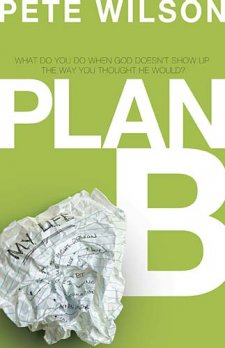
Pete Wilson in Plan B takes his readers through various stages of what happens when one’s plans fall apart, or as Wilson says what happens when God doesn’t show up the way you planned. As a pastor, Wilson lives and works among those experiencing personal tragedies and triumphs. Wilson sprinkles his book with stories of these folks and their Plan B experiences along with Biblical principals pulled from the lives of Biblical figures and the teachings of Jesus. In the end, Wilson admits he does not have easy answers for those facing a Plan B. He readily admits he has no Bow to tie his book together with easy to follow steps to walk one through a Plan B. However he does constantly turns us back to God. He reminds us that God does not change, that God keeps his promises, that God uses Plan B to strengthen our faith in him, and regardless of the resolution and our own perceptions of it, He will finish what he started. In the end, while there may not be easy answers, we do have God and his love for us.
I read this book in the middle of my own Plan B situation, in fact, maybe a few Plan Bs. So I found the book timely and encouraging. It was a long time ago since I wanted to be an astronaut and not that long ago my heart screamed to be in fulltime ministry. It has become clear throughout these experiences, Wilson is right. As rough as I may have felt the situation was at times, God clearly was with me. And I have had to constantly reconfigure my own view towards planning. I now find that when I am open to the movement of God, I am less likely to be shattered by plans that did not happen and also have greater rewards. I also appreciate Wilson’s frankness. He does not attempt to set up 7 easy steps towards success in my plan B. Instead he shows how Jesus, Joseph and others from the Bible faced their Plan Bs (both successfully and poorly). I honestly appreciate that he does not try to solve every problem with a Band-Aid of clichés. In the end, Wilson had crafted a nice resource for those facing challenges to their hopes and dreams.
Review Copy provided by Thomas Nelson
Wednesday, April 21, 2010
Wild at Heart: Discovering the Secret of a Man’s Soul (Revised) by John Eldredge

John Eldredge in Wild at Heart argues that a desire for adventure has been knitted into the heart of everyman. He believes that everyman wishes to be the warrior, the adventurer, the knight, and the hero and that American culture, including the church, has attempted to suppress these God written desires of a man’s heart. Eldredge gives his reader permission to unlock those desires and unleash the wild man within them. Much of the focus in unlocking a man’s heart is the realization of a spiritual wounding, likely caused by a father figure and a establishment with of proper relationship with one’s heavenly father. By allowing men to return to their nature of wildness, Eldredge challenges his reader to participate in the great adventure that life and a relationship with God provide.
This is the revised edition of Wild at Heart, a book I have known of for several years. I had avoided it fearing Eldredge would challenge me to move into the woods for an extended period of drum playing and living off berries. I found that my reluctance to read Wild at Heart earlier to be a mistake. The text speaks to a man’s soul, with Eldredge hitting on themes such as the desire for adventure that resonates with everyman. Additionally, I have found that the content has led to other deep spiritual conversations with other men. In the end I find myself reflecting on The Lion, the Witch and the Wardrobe. Aslan is described as a safe but not tame lion. I find myself after reading Eldredge why have I allowed myself to become tamed and how to I return myself to the wild and give my son permission to never be tamed.
Review Copy provided by Thomas Nelson
Tuesday, December 15, 2009
Primal: A Quest for the Lost Soul of Christianity by Mark Batterson
Mark Batterson in Primal: A Quest for the Lost Soul of Christianity challenges the church to question the current state of Christianity. Batterson finds our faith to be educated, civilized and generally acceptable to the world while losing its power, compassion and authenticity. To regain these lost elements Batterson drives us to the essence of our faith in the Primal Commandment Mark 12:30:
Love the Lord your God with all your heart and with all your soul and with all your mind and with all your strength.
Batterson charges the church with not striving to be great with the commandant, in fact he states the church often is not even good at this charge. The author argues that in order to regain its God given authority, the church and individuals must excel at this essential directive. Batterson then examines the pieces of the primal commandant; heart, soul, mind and strength for his reader. Batterson concludes with a call for a new reformation based on believers who have learned to excel at this basic command.
Though Batterson’s material may seem similar to some readers, Batterson’s voice provides a new take on calls for authentic faith and response. Batterson enjoys science and understanding how things work, reinforcing his faith by understanding the complexity of the world. Batterson the pastor shows a willingness to experiment; seeing movie theaters as a platform for delivering the gospel. Multnomah Books and Batterson are encouraging Christians to consider this book as their first read in 2010 sparking a Primal movement. For some readers this book could serve as a good introduction to emergent thought and a challenge to foster a passionate relationship with God that surpasses apologetics and involves the readers mind and soul. For other readers much of the book will seem to reinforce the thoughts of other authors that have called the church to return to the essentials of the faith. For both audiences this book could be a fruitful first read for 2010, though perhaps not essential.
Review Copy provided by Multnomah Books
Monday, October 26, 2009
The Tallest of Smalls by Max Lucado

In the town of
Overall this is a very cute book with great illustrations that help engage children to the text. My daughter pointed out visuals that corresponded with the story, furthering the experience. However, despite its cuteness the book does fall a little flat in some areas. The cover advertises a tie-in to the adult Lucado book Fearless. However, readers not familiar with that book will have a hard time connecting this children’s story with the topic of fear. Also in many ways this book feels like another telling if the Punchinello You are Special story which shares a common theme with this book, but Punchinello is more subtle and effective in execution.
Review Copy provided by Thomas Nelson
Subscribe to:
Posts (Atom)